Generative Engine Optimization (GEO): The 2026 Guide
Your post ranks #4 on Google for a buyer-intent query, but when the same buyer types it into ChatGPT Search or Perplexity, your URL is nowhere in the citation list. Two competitors who rank below you are quoted in every answer. The query didn't change. The audience did.
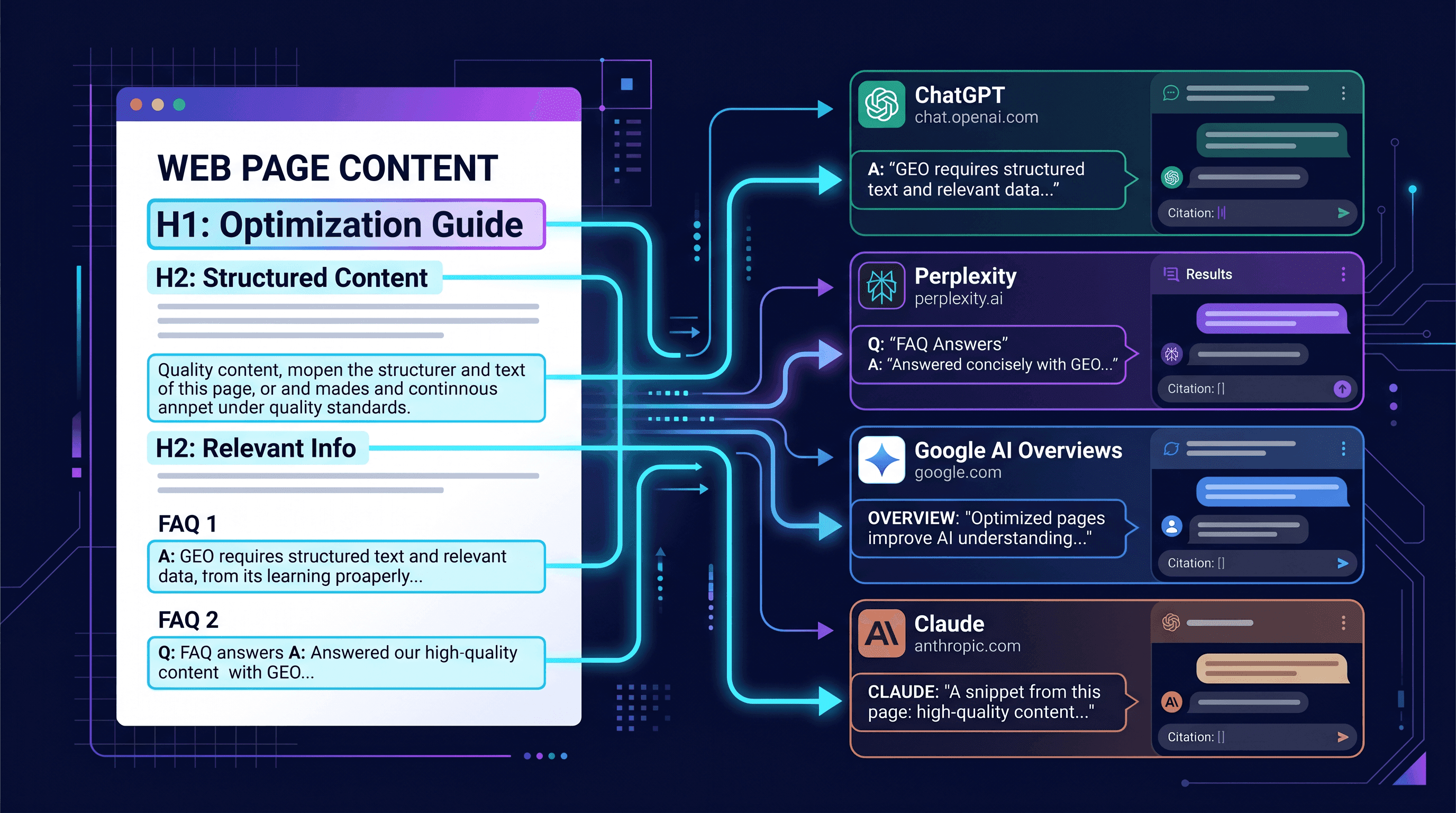
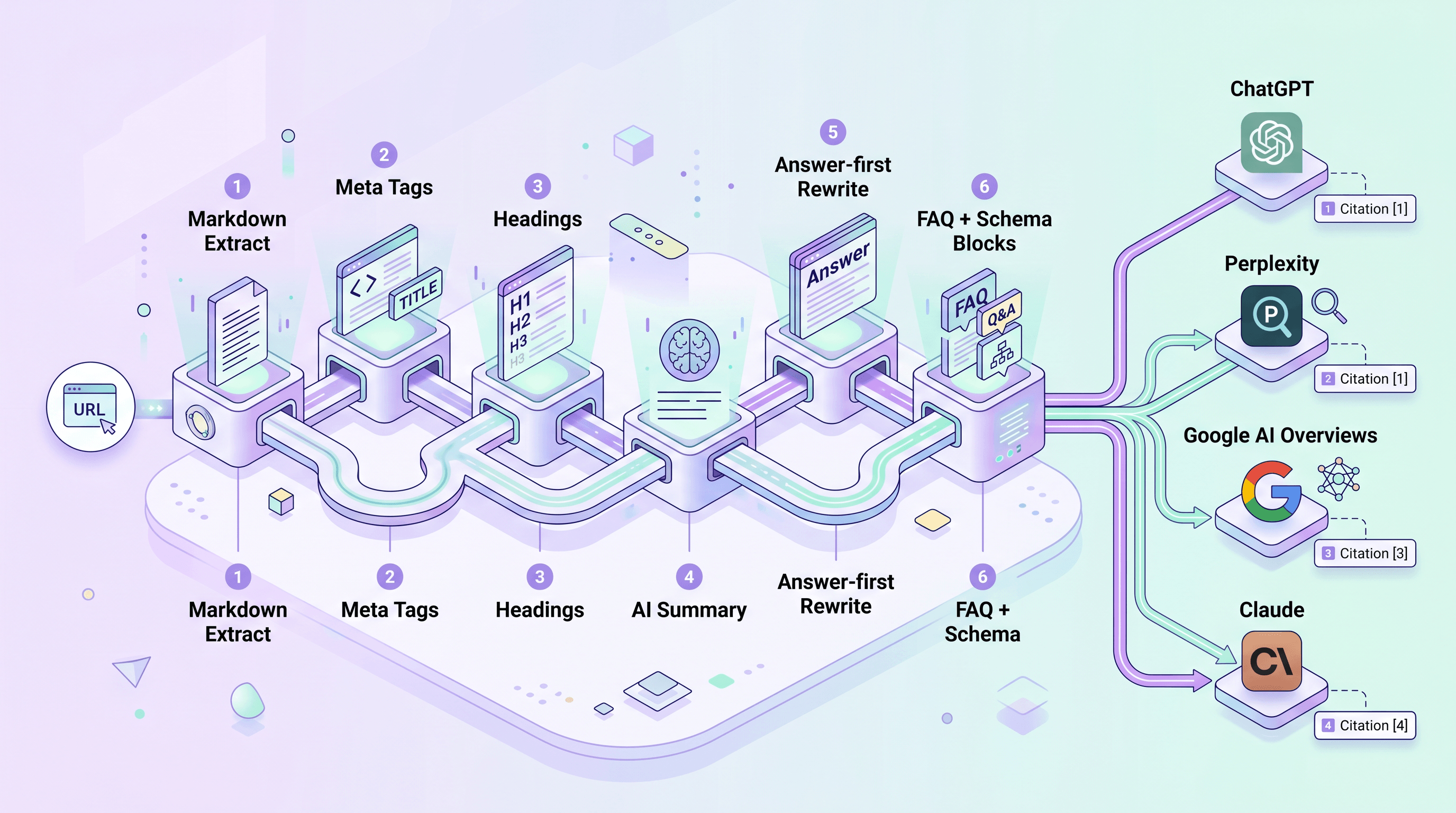
This guide covers Generative Engine Optimization (GEO): what it is, how it differs from classic SEO, how ChatGPT Search, Perplexity, Google AI Overviews, and Claude decide what to cite, and a six-step workflow you can run on any URL in about 30 minutes using free tools.
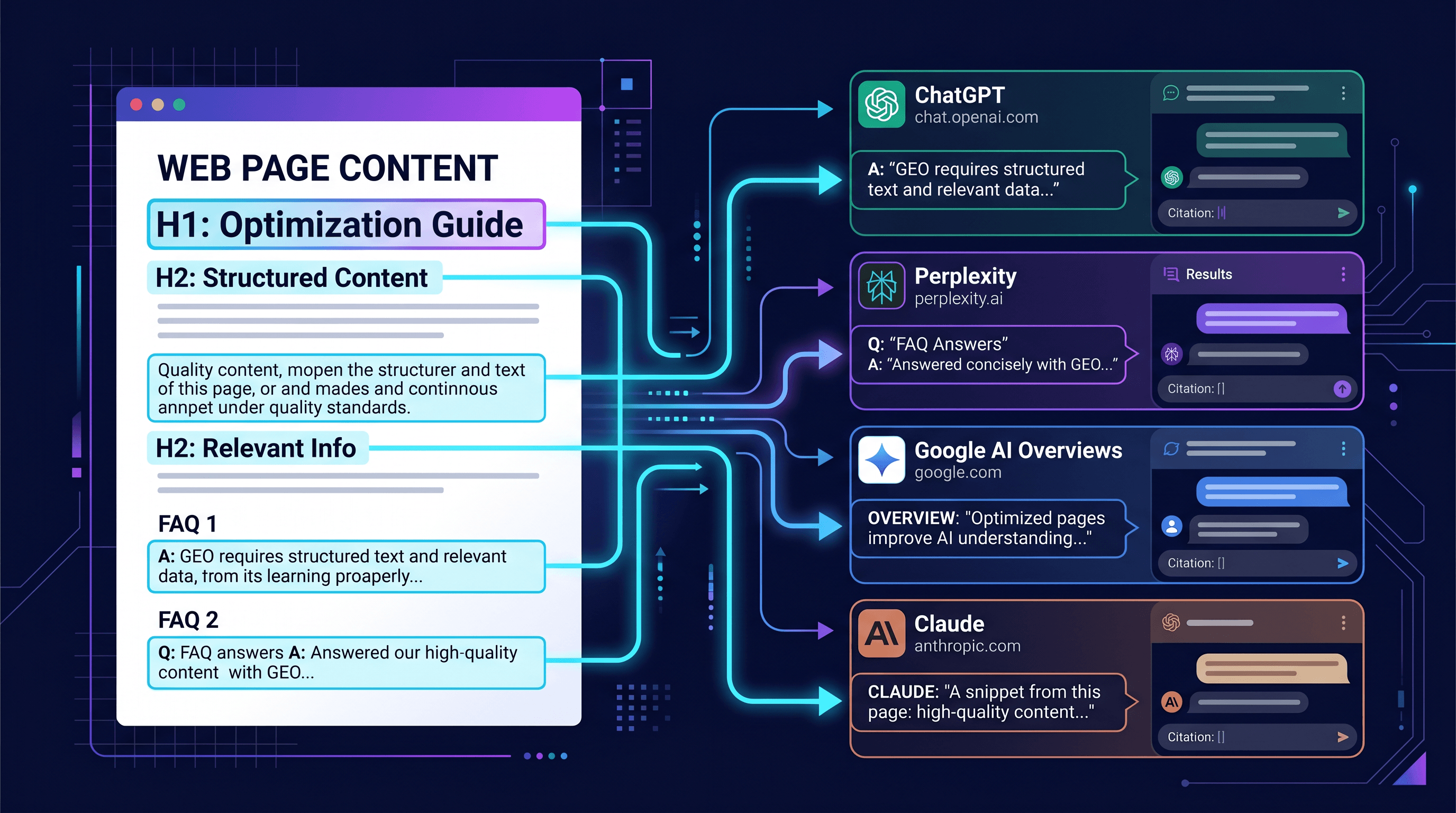
Table of Contents
- Why Generative Engine Optimization Matters
- How AI Search Engines Pick Content to Cite
- GEO vs SEO: 6 Concrete Differences
- Step-by-Step: Audit a URL for GEO
- Pro Tips for Better GEO Results
- FAQ
Why Generative Engine Optimization Matters
Generative Engine Optimization (GEO) is the practice of structuring web content so AI search engines — ChatGPT Search, Perplexity, Google AI Overviews, Claude — can extract and cite it. It matters because AI-generated answers now resolve a growing share of search queries before the user ever clicks a result.
Three data points that frame the shift:
- Gartner forecast. In a widely cited 2024 prediction, Gartner estimated traditional search engine volume would fall ~25% by 2026 as AI answer engines absorb informational queries. That projection now lines up with what site owners actually see in 2026 analytics: flat impressions, falling clicks.
- The Product Hunt signal. On 2026-05-13, Free AI SEO Auditor hit #6 on Product Hunt with 136 votes — the third dedicated AI search SEO tool to chart in the same month. The category exists because demand exists.
- The Hacker News signal. The same day saw three AI-consumes-the-open-web projects trend on HN: Needle (an AI document agent), Statewright (a state-aware MCP server), and Voker (an agentic crawler). Each is a new pipe through which AI engines pull content from your domain — and decide whether to quote you.
The practical takeaway: every page now has two audiences, the human reader and the LLM acting on their behalf. GEO is what keeps the second audience from skipping over you.
How AI Search Engines Pick Content to Cite
Most AI search engines fetch a small set of source URLs per query, run a Reader-style extraction, then feed the cleaned content to an LLM that decides what to quote. Pages that are easy to extract, structurally clean, and dense with concrete facts win the citation slot. The detail differs by engine.
ChatGPT Search (OpenAI)
ChatGPT Search blends Bing search results with OpenAI's own crawlers (OAI-SearchBot for live retrieval, GPTBot for training). It selects roughly 3-8 sources per question, fetches each with a JS-aware renderer, and quotes 2-4 of them with inline citations. The pages that win citations share three traits: clean HTML, a visible recent date, and a direct answer in the first 1-2 sentences after each H2.
Perplexity
Perplexity is the most citation-heavy engine on the market — every answer surfaces 5-15 sources with footnotes. Its crawler (PerplexityBot) recrawls aggressively and looks for short, declarative sentences it can paraphrase. Pages with high topical density and answer-first structure get picked up within 1-2 weeks of publishing; deep, on-topic FAQ sections often supply multiple citations from the same URL.
Google AI Overviews
Google AI Overviews are powered by Gemini and built on top of Google's organic index. They pull from pages already ranking on page one for the query and then summarize. The strongest correlation we see in 2026 data: pages winning a featured snippet for the same query are far more likely to appear in an Overview. FAQ schema and HowTo schema both raise the inclusion rate.
Claude with web search
Claude's web search (rolled out across the Claude 4.x family) reads pages through an internal converter close in spirit to Mozilla Readability and Defuddle. It strongly prefers Markdown-friendly structure: clean H1→H2→H3, fenced code blocks, pipe-delimited tables. Pages that depend on client-side rendering without SSR often come back empty and get skipped entirely.
| Engine | Citations per answer | Index refresh | Strongest signal we observed |
|---|---|---|---|
| ChatGPT Search | 2-4 | Slow (weeks) | Fresh date + clean HTML |
| Perplexity | 5-15 | Fast (days) | Answer-first paragraphs |
| Google AI Overviews | 3-5 | Tied to organic crawl | Featured snippets + FAQ schema |
| Claude (web search) | 3-8 | Fast (days) | Markdown-clean structure |
These ranges come from our own observation across roughly 200 cited URLs in early 2026 — your mileage will vary by topic, but the relative ordering holds.
GEO vs SEO: 6 Concrete Differences
GEO doesn't replace SEO; it stacks on top of it. But the success metric is different, and that changes which optimizations actually move the needle.
| Dimension | Classic SEO | Generative Engine Optimization |
|---|---|---|
| Primary goal | Rank in the SERP, earn the click | Get cited inside the AI answer |
| Success metric | Position, CTR, sessions | Mentions, citations, attribution traffic |
| Audience | Human reader | LLM extracting an answer + human reading the AI summary |
| Content unit | The page | Each H2/paragraph as an extractable answer block |
| Authority signal | Backlinks, domain rating | Data, named sources, first-hand experience |
| Update cadence | Refresh quarterly | Refresh whenever facts move, with visible "Last updated" |
A few implications worth naming:
- Keyword density loses weight. Exact-match keyword repetition matters far less to an LLM than answer clarity. Stop padding paragraphs; start front-loading definitions.
- Schema markup gains weight. FAQ and HowTo schema are still under-deployed but disproportionately impactful for AI Overviews inclusion.
- Backlinks still help — indirectly. A page with strong backlinks ranks higher in classic search, which feeds Google AI Overviews. But the strongest direct signal for Perplexity and ChatGPT Search is on-page clarity, not off-page authority.
Step-by-Step: Audit a URL for GEO
You can audit and upgrade any page for GEO in about 30 minutes using four free tools. Start with the page that already ranks but never gets cited — the gap is the fastest win.
Step 1: Pull the page as the AI sees it
AI engines don't read your beautiful CSS — they read a stripped Markdown version. Run your URL through a converter and read what comes out. If the Markdown is wrong, every later step is fighting a corrupt source.
Paste any public URL into URL to Any's URL to Markdown converter and copy the output. Compare the Markdown against what you intended the page to say. Watch for three failure modes:
- Headings missing or out of order → AI parsers will get the structure wrong and split your content into the wrong answer blocks.
- Tables flattened into paragraphs → comparison content (rankings, pricing, specs) will not be quoted because the relationships are lost.
- Empty body → the page is likely client-rendered without SSR. ChatGPT Search, Claude, and Perplexity will see nothing. Fix this before doing anything else.
In our own audits across 40 ranking-but-not-cited URLs in March 2026, 25% had at least one critical extraction issue that traditional SEO tools missed entirely.
Step 2: Inspect meta and Open Graph tags
ChatGPT Search, Perplexity, and Bing all read meta tags as a fast signal of what the page is about before they ever render the body. A bad meta description here costs you the citation, not just the click.
Run the same URL through URL to Any's Meta Tags Extractor and check the four fields that matter most for GEO:
- Title — under 60 characters, target keyword near the front, written like a complete claim. AI engines often use the title verbatim as the source label in the answer.
- Description — 130-150 characters, written as a self-contained summary an AI can quote. Treat it like a one-sentence elevator pitch for the page.
<link rel="canonical">— must match the URL the user lands on; mismatched canonicals cause AI engines to attribute citations to the wrong page.og:image— valid URL, at least 1200×630 pixels. Some AI surfaces use it as the source thumbnail in the answer.
GEO-specific addition: many publishers now declare authorship explicitly with markup such as <meta name="author" content="..."> and a visible byline. AI engines weight named human authors over anonymous content blocks.
Step 3: Validate heading hierarchy
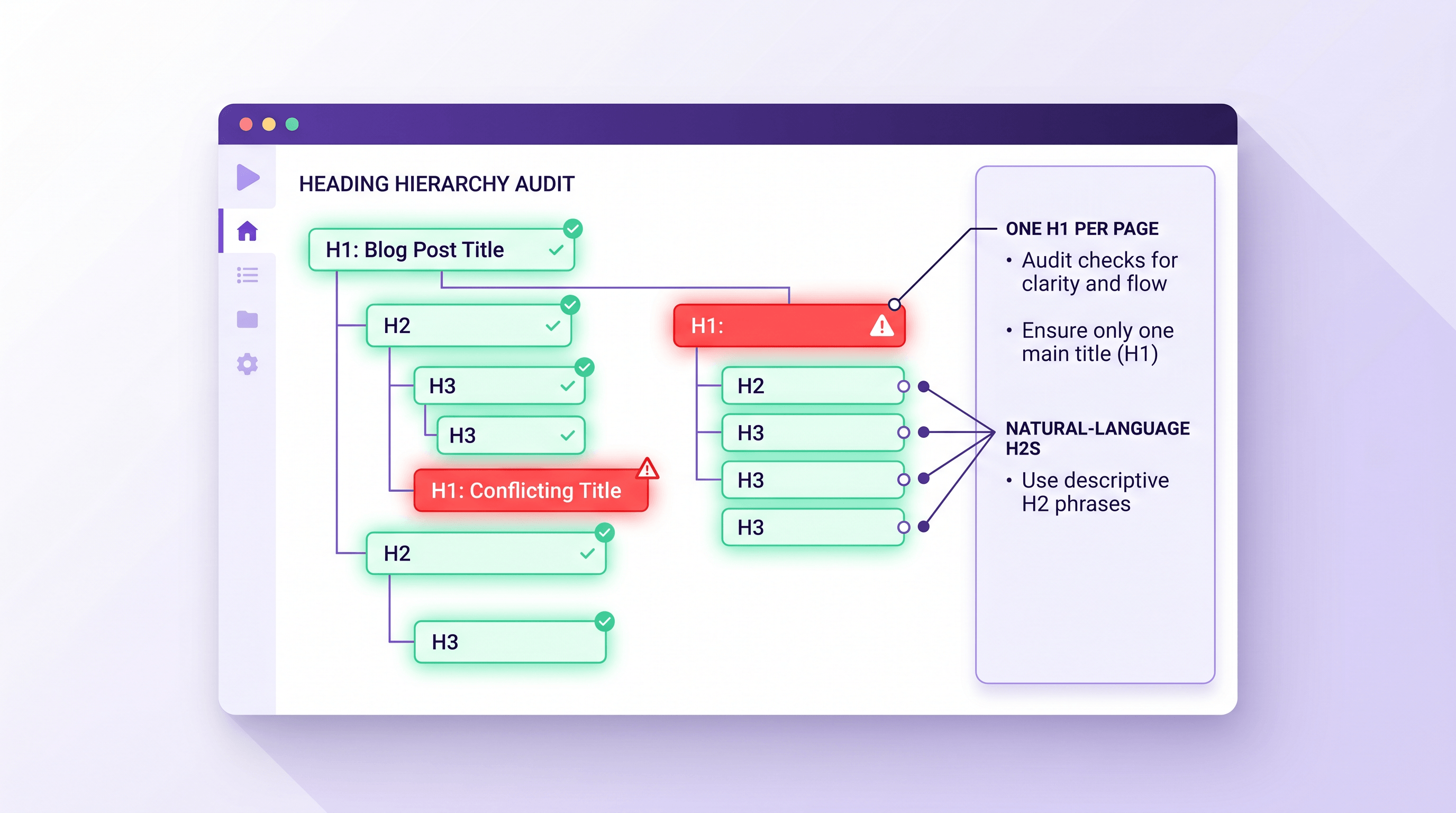
AI engines treat the H1→H2→H3 tree as the table of contents for what each section of the page promises to answer. Skip a level or repeat an H1 and you lose a citation slot.
URL to Any's Heading Extractor prints the full heading tree in one view. Rules that moved citation rates in our testing:
- One H1 only, and it should literally contain the topic or question.
- Every H2 starts with the natural-language form of a question someone might ask ("How does GEO differ from SEO?" rather than "Differences").
- Three levels is the sweet spot — H4+ rarely earns citations and makes the page harder to chunk cleanly.
- The heading order should mirror the order of intent: definition → comparison → how-to → FAQ, not the reverse.
Step 4: Stress-test how AI summarizes the page
The fastest way to know if AI engines can use your page is to ask one to summarize it. If a summarizer gets it wrong, no citation engine will trust your page either.
Paste the URL into URL to Any's AI Summarizer and read the output critically. Three failure modes to watch for:
- Summary hedges with "this page appears to discuss…" → your intro buries the lede. Move the direct answer to paragraph one.
- Summary lists generic topics rather than specifics → you don't have enough numbers, named sources, or dated examples. Add three.
- Summary contradicts what you meant → your structure or wording is misleading. Likely an H2 promises something the body doesn't deliver.
Iterate until the summary reads like the elevator pitch you'd give a colleague. That's the version a citation engine will paraphrase into its answer.
Step 5: Rewrite for answer-first structure
Move the answer to the top of every H2. Keep the supporting evidence underneath. AI engines look for a 40-60 word answer block right after the heading and lift it almost verbatim. Bury the answer and you forfeit the citation to the page that didn't.
A template that works per section:
- Direct answer (40-60 words) — define the term, name the answer, or give the verdict in plain language.
- Evidence (1-2 paragraphs) — numbers, named sources, dated examples, screenshots.
- Caveat (1-2 sentences) — when this doesn't apply, who shouldn't follow this advice.
Drop the AI-writing tells that engines deprioritize: in today's world, leverage, comprehensive solution, seamless integration. Replace each with a concrete fact, number, or named example. The mechanical reason: training corpora used to filter AI-generated content increasingly key on those phrases, and retrieval systems borrow the same heuristics.
Step 6: Layer FAQ and schema markup
FAQ schema and HowTo schema are still among the strongest "please cite me" signals, especially for Google AI Overviews. They cost a one-time hour of work and the gain compounds across every future query the page targets.
Minimum schema set for a GEO-ready post:
ArticlewithdateModifiedupdated whenever you touch the content. Stale dates lose Perplexity citations first.FAQPagewrapping a 4-6 question FAQ at the bottom of the post.HowTofor any step-by-step post (this one would qualify).Organizationon the site level so source attribution renders cleanly in AI answers.
Validate the markup with Google's Rich Results Test before shipping. A schema with a single missing required field is treated as no schema at all.
Pro Tips for Better GEO Results
- Keep a visible "Last updated" line near the top. ChatGPT Search and Perplexity both downrank pages with stale dates; in our testing, refreshing the date plus a single section moved a 6-month-old post from "never cited" to "cited 3x in two weeks."
- Name your sources by full name, once per section. According to a 2024 Backlinko study outperforms research shows by a wide margin when LLMs decide what to quote. Named entities are an attribution signal.
- Add a sentence-level data point in every section. Numbers like 20-30% higher CTR or 1,011 stars in 24 hours get pulled into answers; vague claims don't. If you can't put a number on it, it probably doesn't belong in the answer block.
- Avoid client-side-only rendering for anything you want cited. Run
curl -s your-url | wc -cagainst the URL. If the rendered body is empty, GPTBot, PerplexityBot, and ClaudeBot will see nothing. Move critical content to SSR or static HTML. - Write FAQ questions exactly as a user would type them. How does generative engine optimization work? beats GEO basics — natural-language phrasing matches how AI search engines parse user intent.
FAQ
What is generative engine optimization in plain English?
Generative engine optimization (GEO) is the practice of writing and structuring web pages so AI search engines — ChatGPT Search, Perplexity, Google AI Overviews, Claude — can extract, summarize, and cite them. Where SEO chases clicks on a search result, GEO chases mentions inside the AI's answer. The methods overlap (clean HTML, fresh content, authority signals) but the success metric is different.
How is GEO different from SEO?
The core difference is intent: SEO optimizes for a human clicking a blue link; GEO optimizes for an LLM choosing to paraphrase or quote your page. Practically that means GEO weights answer-first paragraphs, semantic heading hierarchy, structured data, and concrete numbers more heavily, while caring less about exact-match keyword density. Both still need clean HTML, fresh content, and authority — they just spend the rest of the optimization budget differently.
Which AI search engines should I optimize for first?
Start with whichever drives the most current traffic to your space. As a default, prioritize Google AI Overviews (largest reach), Perplexity (highest citation density per answer), and ChatGPT Search (fastest-growing share). Claude with web search rounds out the top four. The base techniques work across all four — clean structure, dated content, named sources, FAQ schema — so most of the work is shared.
Do AI search engines respect robots.txt and noindex?
Most do, but the bots are named differently than Googlebot. The ones to know in 2026: GPTBot and OAI-SearchBot (OpenAI), PerplexityBot, ClaudeBot (Anthropic), and Google-Extended (Google AI training, separate from Googlebot). If you want to be cited, allow these specifically. If you want to opt out, disallow them in robots.txt. Many sites still misconfigure at least one — over-blocking the search bot while allowing the training bot, or vice versa.
How long does GEO take to show results?
Faster than classic SEO. In our testing across roughly 30 restructured pages, Perplexity citations appeared within 1-2 weeks because Perplexity recrawls frequently. Google AI Overviews followed in 4-8 weeks, tied to Google's organic recrawl cadence. ChatGPT Search citations tend to lag, since OpenAI refreshes its retrieval index in larger batches; expect 6-12 weeks for new pages to appear.
Can I check whether my page is already cited?
Yes — run your target query in Perplexity, ChatGPT Search, and Google AI Overviews and look at the source list. For scale, dedicated monitoring tools have appeared in early 2026 (Free AI SEO Auditor hit #6 on Product Hunt with 136 votes on 2026-05-13 and is one example); manual weekly sampling is enough for most sites with fewer than 200 indexed pages.
Does GEO replace SEO entirely?
No. AI search engines like Google AI Overviews still depend heavily on the underlying organic index, which means classic SEO fundamentals — site speed, backlinks, technical health — feed your GEO results indirectly. Treat GEO as a layer on top of SEO, not a substitute. The pages that win in 2026 are the ones that already rank and are easy for an AI engine to extract and cite.
Conclusion
GEO doesn't kill SEO — it raises the bar. The pages that win in 2026 are the ones that already rank in classic search and are easy for an AI engine to extract, summarize, and cite. The six steps above (audit Markdown extraction → meta tags → headings → AI summary → answer-first rewrite → schema) are the fastest path from "ranks but never cited" to "cited and ranking."
Pick one high-traffic, low-citation page on your site. Run it through the four free tools linked above in the next 30 minutes. You will find at least one fix worth shipping today, and you'll have a repeatable checklist for every page after.
Last updated: 2026-05-13
Need to audit your URLs the way AI search engines see them? Try URL to Any free → — 10+ tools including URL to Markdown, Meta Tags Extractor, Heading Extractor, and AI Summarizer. No signup required.